
Cyber Resilience
The Week Everything Went Down: Treat Every Cyber Incident as an Emergency, Whatever the Cause
November 22, 2026
Between November 12 and 17, a run of high-profile outages hit services that millions of people and thousands of companies depend on. Officials have said they have no evidence of a coordinated cyberattack. I'm writing this on November 22, the story is still moving, and parts of it will date quickly. I have no inside information, so I'll separate what is reported, what is claimed, and what nobody knows yet.
I want to use the week for two things. The first is what it says about disaster recovery and business continuity. The second is how a cybercrime investigator looks at a run of failures when the cause is uncertain. Both lead to the same idea: a cyber incident is an emergency management incident, and it should be run like one.
What happened
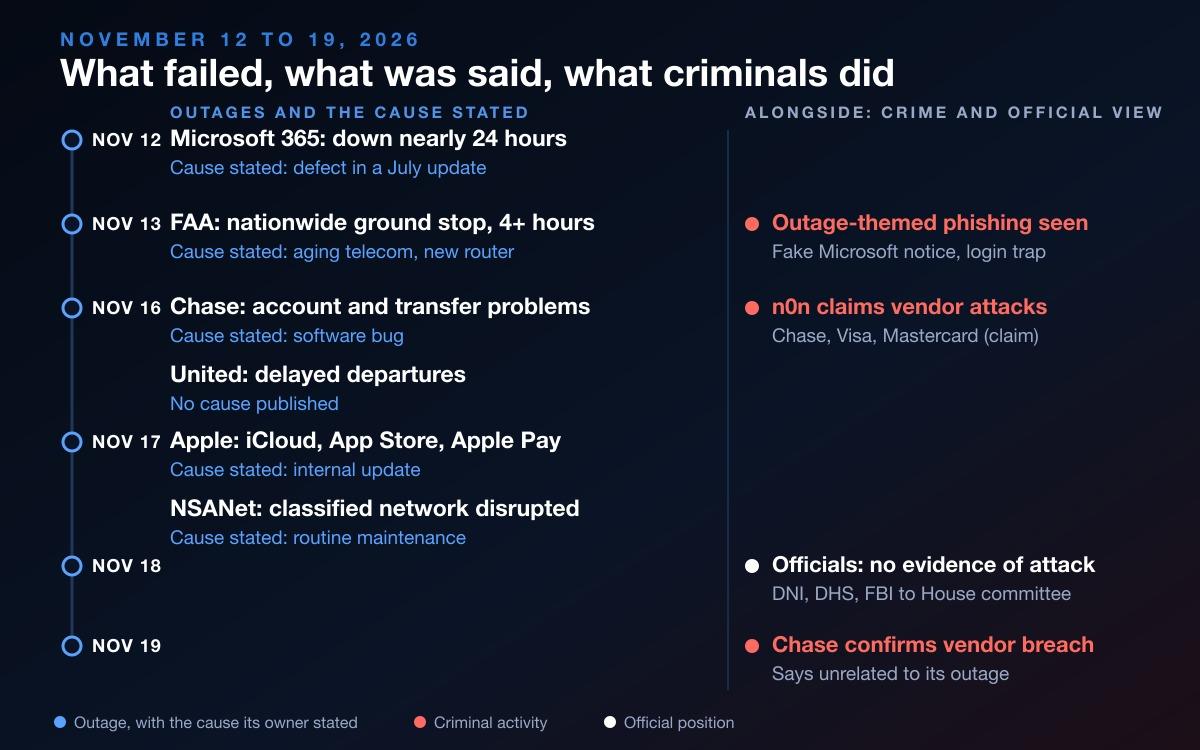
Microsoft 365 went first. On November 12, Outlook, Teams and other services were disrupted worldwide for nearly 24 hours. Microsoft has said a software defect in a July update was involved.
On November 13, the FAA ordered a nationwide ground stop that lasted more than four hours. The FAA pointed to a newly installed router at a communications facility and to aging telecom equipment overwhelmed by excess network traffic, and it has paused new router installations while it works out exactly what went wrong. The FAA has said it has no indication of a cyberattack or an outside actor.
On November 16, Chase customers reported problems with accounts and transfers, with delays at other banks as well. Chase blamed a software bug. The same day, United Airlines delayed departures because of a system problem of its own. I have not found a published cause.
On November 17, Apple had an outage affecting iCloud, the App Store and Apple Pay, and said an internal update was responsible. Marriott reported sign-in problems. And NSANet, the NSA's classified internal network, was disrupted. The agency described it as temporary degradation during scheduled routine maintenance, and said its mission-critical capabilities stayed operational.
Look at what those explanations have in common. Microsoft, the FAA, Chase and Apple each pointed inward: an update, a router, a software bug. None pointed to an attacker.
What is known about the cause, and what isn't
On November 18, the Director of National Intelligence, the Homeland Security Secretary and the FBI's deputy director repeatedly told lawmakers they had seen no evidence that malicious attacks caused the outages. That is the official position, and so far nothing public contradicts it.
A second theory has taken hold in Washington, and I want to be careful with it. The Director of National Intelligence told Fox Business that the NSA outage came from software patches for recently disclosed PHP vulnerabilities, and Reuters reported that those vulnerabilities were found with the help of AI. The Washington Sun, citing three unnamed sources, reported that Wall Street executives and the NSA told Congress the outages came from efforts to fix AI-discovered vulnerabilities. Senator Mark Warner called the situation a consequence of how fast AI is changing cybersecurity, which pushes organizations to patch immediately and often all at once.
Here is what that does not establish. Neither Microsoft nor Chase has attributed its outage to AI-driven patching, and the FAA gave a different, more specific explanation. The NSA's own public statement said routine maintenance. At the hearing, the Director of National Intelligence described the rate of patching as rising without saying the patches came from AI discoveries. One report put Microsoft's October patch count at more than 1,400, about ten times its usual, but I have not confirmed that figure. At most, the patching theory explains one or two incidents. The honest reading is a general condition: complex, aging systems being changed quickly.
If the NSA account does hold, it is the other half of a lesson I wrote about in my PHP2Shell piece. There I said patching isn't the same as clean. This week suggests that patching isn't the same as safe, either.
The cybercrime perspective
First, a point about method. "We have no evidence of an attack" three to five days into an event is a statement about the investigation so far. I take officials at their word, and the explanations are plausible. But the FAA hasn't announced a final root cause, and United hasn't published one. A root cause is established from change records, configuration history and authentication logs, and the public hasn't seen those. That isn't an accusation. It is how I treat any finding at this stage: as preliminary.
What I can say with confidence is what criminals did with the confusion, because that is visible. On November 13, the security firm Field Effect saw a phishing email themed on the Microsoft outage. Its subject began with "Outage," its body imitated a Microsoft quarantine notice saying held messages would be deleted within 24 hours, and it carried an incident ID that matched Microsoft's real one. A "Restore messages" button led to a credential-harvesting page. Security vendors and media also reported fake Outlook password-reset emails and texts, fake Microsoft support offering refunds, and a payment-redirection pretext: our email is down, so send the payment to this new account. I haven't independently verified each of those, but the pattern is a familiar one from earlier outages.
It also connects to my last debrief on the Bay Street law firms. The attackers there used an urgent call from internal IT as the pretext. During an outage, an urgent call from IT is exactly what employees expect. The pretext writes itself.
Real intrusions also kept happening that same week. On November 19, JPMorgan Chase confirmed that outside vendors had been hit in a cyberattack, and said the attackers accessed marketing data that may include customer names and email addresses. An extortion group called n0n claimed responsibility. Reuters reviewed data the group posted and counted more than 16,000 customer email addresses, a figure Chase has not confirmed and Reuters could not verify. Chase said there is no connection to its service disruption. I have no reason to doubt that, and it makes my point. There were two separate problems, one customer experience, and it is hard to tell them apart from the outside. Officials said they saw no sign that adversaries used the patching window to attack, and I haven't seen evidence that they did. But an investigator knows that noise is cover, and that is why the first hours matter.
Nor is any of this a reason to relax about the attackers. Rob Joyce, a former senior NSA cybersecurity official, has said AI isn't inventing new ways to hack but is increasing the pressure to repair old weaknesses. Microsoft's Michael Yeh made the related point that attackers are exploiting existing legacy vulnerabilities. As the French fridge debrief showed, even unsophisticated attackers can cause real disruption.
A cyber incident is an emergency management incident
Emergency managers don't wait for a cause before they respond. They manage consequences: what can't we do, who is affected, what is the safe state, who decides, how do we communicate, and what comes back first. The cause matters, but it is not the first question.
The outage week shows why that matters for cyber. In the first hours of each of these failures, almost nobody outside the organization, and sometimes few people inside it, knew whether they were looking at a bad update or a bad actor. An organization that cannot act until the cause is known will do nothing during the most important hours.
The same framework carries over. Emergency management works in four phases: prevention and mitigation, preparedness, response, and recovery. In my view, the middle two are where cyber programs are thinnest. Response needs a single incident commander, defined roles, regular situation reports and a decision log, the same structure whether the incident is a flood or a ransomware event. Too many cyber plans sit inside IT as a technical playbook. An emergency plan belongs to the business: executives, operations, communications, legal and people from every function that will feel the loss.
Two decisions belong in the plan before the incident, not during it. The first is the safe state. A ground stop is a deliberate trade of availability for safety, and every organization should know what its own version is, and who can order it. The second is evidence. If the cause is unknown, you have to treat it as potentially criminal until you know otherwise. That means deciding in advance when preserving logs and snapshots takes priority over restoring service, and who makes that call. And because a breach and an outage can trigger different legal obligations, such as privacy breach reporting, you need to learn quickly which one you have.
Lessons for disaster recovery and continuity
First, know what's underneath you. Most organizations can name their own systems but not the platforms beneath them: identity, email, cloud hosting, telecom, payments. When one provider carries mail, chat, identity and files, one failure takes all four, and it also takes away the tools you would use to coordinate the response. Plan an out-of-band way to communicate: a phone tree, an alternate messaging channel, a printed contact list, an incident bridge that doesn't run on the platform that just failed.
Second, set recovery objectives by business process, not by system, and test them. How long can the business tolerate losing this process, and how much data can it afford to lose? A backup you haven't restored is a hope.
Third, have a manual mode. Decide what you will do for four hours and for twenty-four when the systems are down: paper, phone, offline customer lists, a reduced service level. This is the difference between an inconvenience and a stoppage.
Fourth, treat change as a risk event. Staged rollouts, rollback plans, maintenance windows and a defined emergency-change process matter more, not less, when everyone is racing to patch. Speed does not excuse skipping the rollback plan. Microsoft's own account points to a defect in a July update that surfaced in November, a reminder that even routine changes can carry delayed risk.
Fifth, hold your vendors to a standard. Ask how fast they will tell you, what they will publish afterward, and what you can do when they are down. As of November 19, several of these organizations, including the FAA and United, had not published a root cause, and Chase's vendor breach is a reminder that your data is only as safe as your supplier's.
Sixth, exercise it with an unknown cause. Run the tabletop that says: it's nine in the morning, email and phones are down, and we don't know why. Include the executives, communications and legal. And practise saying what you know, what you don't, and when the next update is. Public skepticism grows when explanations arrive without detail, and rumour fills any gap you leave.
The takeaway
The outage is the event. The cause is the investigation. Whether it was a bad update or a bad actor matters enormously to the investigation, and it should matter very little to your first hour.
In my work I talk about inherent risk and residual risk. Depending on a handful of platforms is the inherent risk, and it is not going away. What decides your outcome is the residual risk, what remains after your plans have been tested, and that depends on whether you can run an emergency when you don't yet know what kind it is. Canadian organizations run on the same platforms, and the Cyber Centre's recent alerts on PHP and on help-desk voice phishing show the same pressure here. Write the plan, run the exercise, and make sure someone owns the call.