
The KONCYBER framework
CSR5™: How KONCYBER Approaches Cybersecurity
Cybersecurity isn't a project you finish. It's a discipline you practice, on a loop, for as long as the organization exists. CSR5™ is the framework Kenrick Bagnall built to structure how KONCYBER works with clients — the reason five words anchor this site: Risk, Reduction, Resiliency, Response, Recovery.
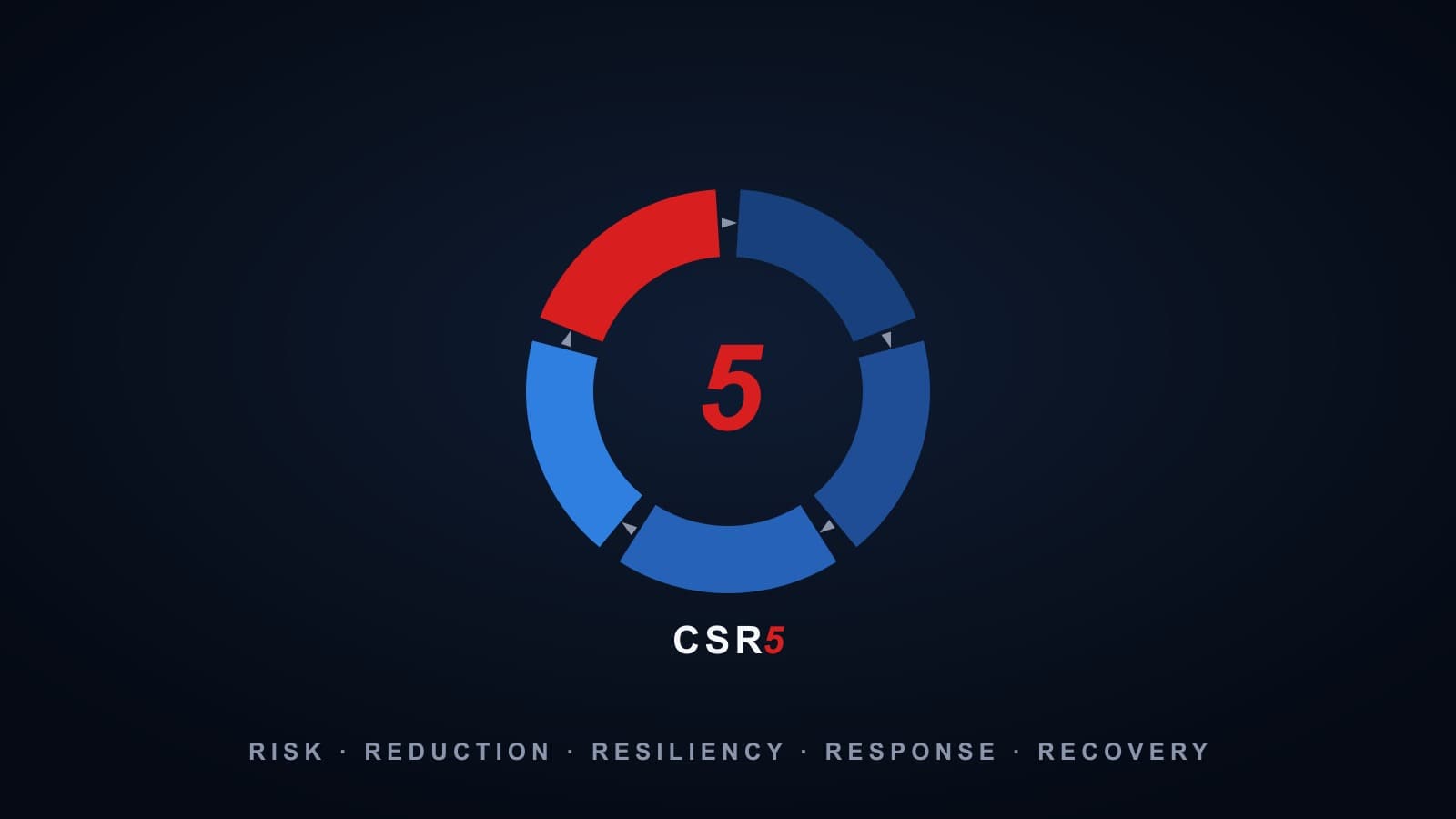
Most engagements fail the same way: they treat one phase like it's the whole job. A vulnerability scan gets mistaken for a security program. An incident response plan gets written once and never tested. A recovery gets treated as the finish line instead of the next round of input. CSR5™ exists to close those gaps — moving through all five phases, in order, and then doing it again.
The framework
The five phases
Risk
Before anything gets hardened, it has to be understood. This phase is a genuine assessment — what's exposed, what's vulnerable, and what a realistic threat actor would actually go after — not a checklist exercise. You can't reduce a risk you haven't measured.
Cybersecurity Advisory & Resilience→Reduction
This is where assessment becomes action: access controls, data protection, network and endpoint hardening, vendor risk management, and the policies that hold it together. Reduction stays deliberately broad, because attackers only need one weak point — most breaches trace back to something ordinary, not something exotic.
Fractional CTO & CISO→Resiliency
Reduction lowers the odds of an incident. Resiliency accepts the odds are never zero, and builds the organization's capacity to keep functioning anyway — incident response plans that are actually rehearsed, business continuity planning, redundancy for what the business can't afford to lose, and regular audits that catch drift before it becomes a gap.
Exercises & Preparedness→Response
When an event happens, the difference between a bad day and a bad year is usually how fast and how disciplined the response is. This phase is detection and analysis, containment before damage compounds, and a communication plan — how an organization talks to its people, customers, and regulators during an incident is itself a risk to manage.
Incident & Investigation Support→Recovery
Recovery is restoring systems and operations — but it doesn't stop there. Every incident is also evidence: what happened, why, what it cost, and what has to change. That post-incident analysis, along with the legal and compliance considerations an event triggers, feeds directly back into Risk. The cycle closes, and the organization comes out harder to hit the same way twice.
Cybersecurity Advisory & Resilience→That loop — Risk informed by Recovery, Reduction tested by Response — is what makes CSR5™ a philosophy rather than a checklist. It's how KONCYBER structures advisory engagements, incident response support, exercises, and executive education alike: not as separate services, but as one continuous discipline.
Put CSR5™ to work for your organization
Every conversation with KONCYBER is confidential.
Schedule a Confidential Consultation