
The Breach Debrief
Breach Debrief: When Hackers Turned Up the Heat on French Supermarket Fridges
October 16, 2026
This is the third entry in The Breach Debrief. I take a real, publicly documented cyber incident, walk the chain of events the way an investigator would, and pull out the lessons - some obvious, some not. This one is different from the first two, because it is still unfolding. Everything below reflects what is public as of October 16, 2026, and some of it will change. I have no inside information, and I'm going to be careful to separate what is confirmed, what is inferred, and what nobody knows yet.
Next up: the French supermarket fridge attack.
What happened
On the night of October 11, attackers took remote control of the refrigeration systems at supermarkets across France and drove temperatures up, in some cases reportedly as high as 50°C. France's finance minister told parliament that about 700 of the country's roughly 10,000 supermarkets were affected. Individual chains and news outlets have reported smaller and differing counts, so I treat the minister's figure as the best available.
The chains named include Intermarché and Netto (Les Mousquetaires), Coopérative U, Carrefour and Monoprix, with E.Leclerc also linked. At Intermarché, fridges were reportedly heated for about six hours overnight, and affected stores threw out the product. Coopérative U said its cold chain held in most of its affected stores, and only a minority lost goods. The head of Les Mousquetaires estimated losses in the tens of millions of euros in a single day; that is his estimate, not an audited figure. There are reports of equipment fires, but the extent isn't confirmed.
No group has claimed responsibility, and Reuters reported no ransom demand. The Paris prosecutor's cybercrime unit is investigating, and the prime minister directed France's cyber agency, ANSSI, to look into it. A researcher at Sekoia told Reuters that Spain, Portugal, Poland, Germany and Belgium were also affected, which governments haven't confirmed.
The chain of events, as far as it's known
Attack: the night of October 11. First alert: on October 12, France's CERT-FR published alert CERTFR-2026-ALE-012, naming Danfoss AK-SC and AK-SM series controllers. Widening: ANSSI later said Copeland and Dixell systems were also targeted, and CERT-FR updated its alert on October 16 to add Copeland xweb and Dixell xweb. Investigation: Paris prosecutors, with ANSSI coordinating with European counterparts.
The access point
The device at the center is a refrigeration controller: a networked box that supervises compressors, defrost cycles and temperature settings, and that maintenance contractors can reach remotely so they don't have to dispatch a technician for every alarm. That remote reach is a feature. It is also the front door.
What the public record supports is narrow. CERT-FR's alert names no vulnerability and no confirmed entry method, but it states plainly that exposing a management interface to the internet goes against good practice, and it warns that leaving an end-of-life device without security patches reachable from the internet carries a very high likelihood of compromise. Danfoss, a Danish company, says most of the affected units were older models that no longer receive security updates, and that others were running outdated firmware.
There is research in the backdrop. Claroty's Team82 published findings on Danfoss's AK-SM 800A controller, including an authentication bypass in its web interface (CVE-2025-41450), and reported thousands of management interfaces reachable from the internet. Danfoss fixed those flaws in firmware released well before this attack. No official has said those flaws were used in France, and I want to be clear that I'm not saying so either.
So the access point, on the evidence so far, is an internet-reachable management interface on a refrigeration controller. How the attackers got past its login, I can't tell you, and neither can anyone else publicly yet. An unresolved entry method is itself a finding, and I'd rather say so than fill the silence with a guess.
Tactics and techniques
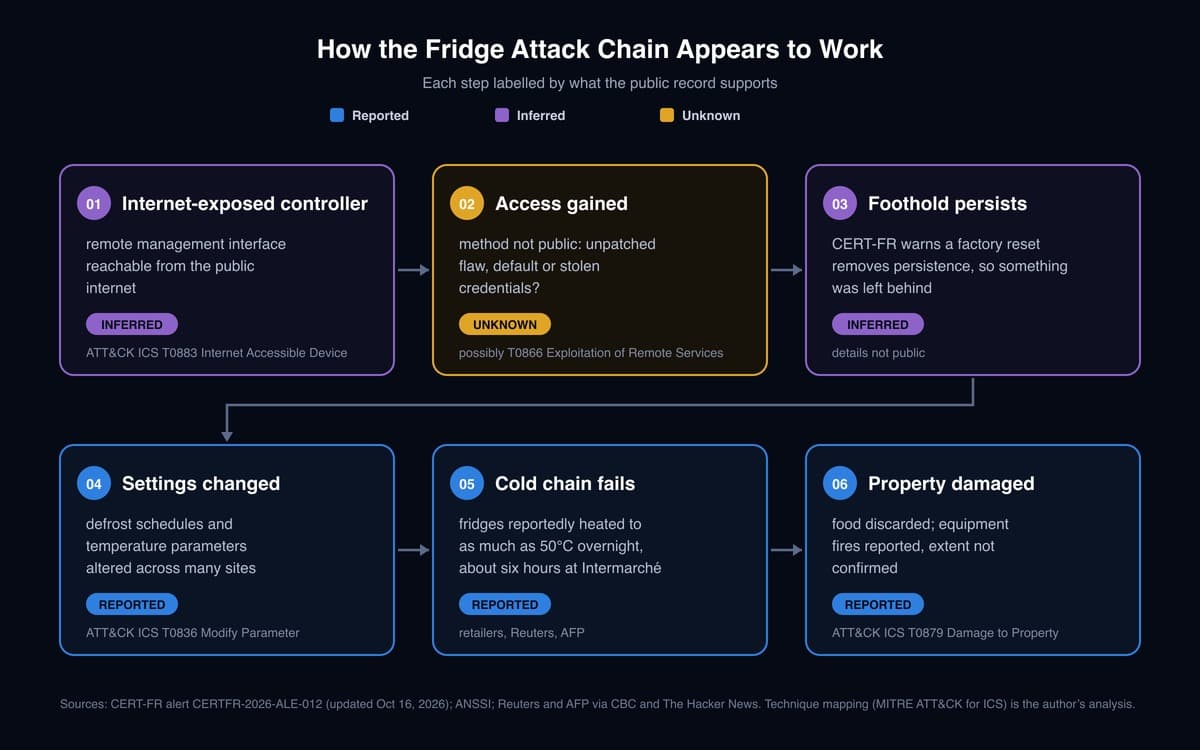
Here is how I read it, mapped to MITRE ATT&CK for ICS, the framework for industrial control environments. This is my analysis. The labels on the graphic below show how strongly the public record supports each step.
Initial access: Internet Accessible Device (T0883). The common thread across Danfoss, Copeland and Dixell systems isn't a particular retailer. It's a type of device that was reachable from the public internet. That points to attackers choosing victims by exposure, not by identity. Whether they then used an exploit (Exploitation of Remote Services, T0866), default credentials or stolen ones is the open question.
Persistence. CERT-FR warns that a factory reset removes persistence but leaves the device open to reinfection. That tells me the attackers left something behind on at least some devices, and that cleaning up is not the same as closing the door.
Impact: Modify Parameter (T0836) and Damage to Property (T0879). They didn't need classic malware to hurt anyone. They changed the controller's own settings, defrost schedules and temperature parameters, and let physics do the rest. CERT-FR's advice to review defrost schedules supports that reading.
Operational signature. Many sites, several chains, more than one country, and an overnight window when stores were unattended: that looks scripted and automated, not hand-built for one retailer. Motive is unknown. It could be disruption, a demonstration, or staging for extortion. As I said in the Ashley Madison debrief, motive is a poor predictor of danger, and the absence of a ransom note is not the absence of intent.
Lessons, obvious and not
The obvious one: management interfaces don't belong on the public internet. If a contractor needs remote access, put it behind a VPN or a protected network. CERT-FR says filtering by the contractor's IP address is acceptable only as a temporary measure.
Second: you can't patch what is no longer supported. If a device is end-of-life and reachable, the options are to take it off the internet, isolate it or replace it. And you can't do any of that for a device you don't know you have. Most organizations I deal with can list their servers and laptops, but not the controllers in their cold rooms, heating and cooling, door systems and cameras.
Third, and this one has history. In 2013, the Target breach began with credentials stolen from a refrigeration and HVAC contractor. Thirteen years later, the remote access built for refrigeration contractors is again at the center of the conversation. I'm not saying this was a contractor compromise, because the entry method isn't known. I'm saying the blind spot is the same: building systems, and the vendors who service them, are rarely treated as part of the network.
Fourth, less obvious: the thing watching the controller shouldn't be the controller. If a compromised controller reports its own temperature, it can report whatever it's told to. An independent sensor with its own alerting path, plus a manual check routine, is cheap insurance. Some chains have said that quick reactions by staff limited their losses. That kind of resilience doesn't depend on the system that was compromised.
Fifth: patching the published flaws is good hygiene, but don't let it become the story. The Claroty findings are real, fixed, and a good reason to update. But the entry method hasn't been established, and an organization that patches one vulnerability and calls itself done may have solved a problem it doesn't have, while the one it does have stays open.
Sixth: this is the same lesson at every scale. The same class of device, a networked appliance with a management interface reachable from outside, sits in homes and small offices too: cameras, thermostats, smart appliances. When I look at how a house or a small office is wired, the questions are the same. What is reachable from outside, who put it there, and is it still supported?
The takeaway
Strip away the novelty of attacking fridges and this is an old, ordinary failure: a device built for convenience, reachable from the internet, often no longer supported, in an environment where nobody owned its security. What changed is the consequence. We've spent years talking about breaches in terms of data. This one is measured in discarded stock, spoiled food and equipment reported to catch fire.
In CSR5™ terms, the failure sits in Risk and Reduction: knowing what you have and closing the easy openings. Where the damage was contained, the credit goes to Resiliency: people who noticed, and a way to keep the cold chain going without trusting the compromised system. Fix the exposure. But also ask what you would do at 2 a.m. when the thing that watches your temperature is the thing that has been compromised.