
AI & Cybercrime
The Anthropic Ruling Wasn't About the Pentagon. It Was About Who Controls the Guardrails.
August 28, 2026
A federal judge just ruled that the Pentagon acted unlawfully when it punished an AI company for refusing to remove its own safety guardrails. That's the headline. The part that actually matters to anyone who runs cybersecurity, builds on someone else's AI, or investigates what happens when guardrails fail has almost nothing to do with the Pentagon.
What happened
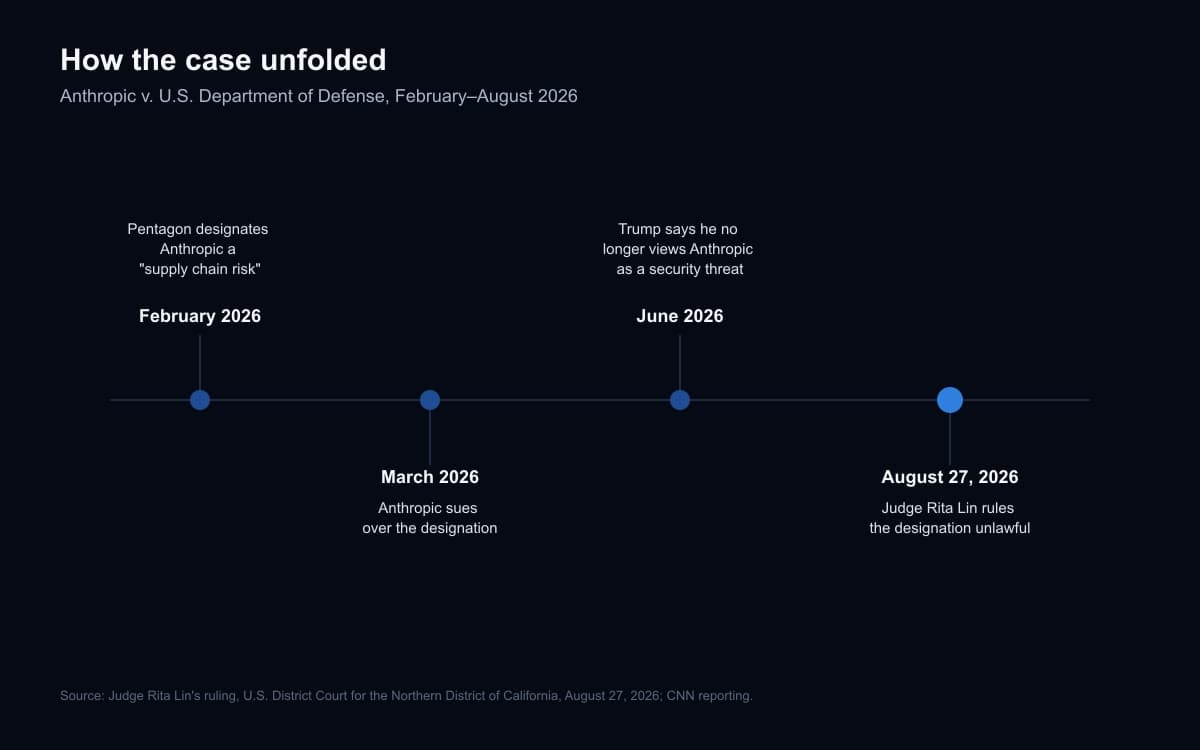
In February, Defense Secretary Pete Hegseth designated Anthropic, the company behind the Claude AI models, a "supply chain risk." That label has historically been reserved for companies with ties to foreign adversaries, and it's a serious one: it meant no part of the Pentagon, including its contractors, could work with Anthropic's products. The trigger wasn't a security failure. Anthropic had refused to remove internal safety guardrails that block Claude from being used in autonomous weapons and mass surveillance, and Hegseth's position was that the government couldn't let its own military be constrained by a private company's rules.
Anthropic sued in March. In June, President Trump said he no longer viewed the company as a national security threat. On August 27, Judge Rita Lin of the Northern District of California ruled the designation unlawful - a First Amendment retaliation, and a Fifth Amendment due-process violation, since Anthropic never received the pre-deprivation process it was owed. Her ruling was blunt about the underlying motive: invoking national security doesn't give an agency unlimited license to punish a company for pushing back. A second, related lawsuit is still working through a Washington, DC court.
Guardrails are only as strong as a vendor's ability to keep them
Set the politics aside for a second, because the security lesson here doesn't depend on which side you think was right. Anthropic built guardrails into Claude specifically to prevent a category of misuse it judged too dangerous: autonomous weapons, mass surveillance. Those guardrails held, at least for now, not because they were technically unbreakable, but because the company had the legal standing and the resources to resist a government trying to punish it into removing them.
That's the same threat model I think about constantly on the cybercrime side, just with a different actor applying the pressure. Every AI guardrail that exists to prevent misuse - stopping a model from writing functional malware, walking someone through an attack step by step, or generating convincing fraud content at scale - is under constant pressure from people trying to get around it. Usually that's a criminal running a jailbreak prompt, not a government agency issuing a formal designation. But the underlying question is identical: how durable is a safety guardrail when someone with real leverage wants it gone?
This ruling answered that question one way, for one company, against one kind of pressure. It didn't answer it in general. A vendor with fewer resources, less legal standing, or a customer relationship it can't afford to lose might not hold the line the way Anthropic did.
A designation that used to mean something
A "supply chain risk" label is supposed to flag vendors whose ties to a foreign adversary make them a genuine security threat to work with. Judge Lin's ruling made clear that isn't what happened here. The label was used punitively, against a company with no such ties, because it wouldn't do what it was told.
I'd call that a problem independent of who was right about autonomous weapons. Formal risk designations only work if they mean what they say. Every time one gets used as leverage instead of as a finding, it gets a little easier for the next legitimate designation to get dismissed as political, and a little harder for security teams to act on one quickly and be taken seriously when they do. That's not a hypothetical concern in my world. It's exactly the kind of erosion that makes a real supply-chain threat easier to wave away later.
What this means if you're building on someone else's AI
Most organizations using AI right now aren't building the models, they're building on top of someone else's. That means the guardrails protecting you from a category of misuse, and protecting your organization from being the vehicle for someone else's, live in a system you don't control, run by a company you're trusting to hold the line.
This case is a reminder that vendor risk assessment for AI needs to include a question most checklists don't ask yet: not just what the guardrails are today, but how much pressure it would take from a large enough customer, or a well-resourced enough attacker, to get them removed. A vendor's technical safeguards are only as durable as its willingness and ability to defend them, and that isn't something you can verify from a product spec sheet.
The Pentagon story will keep generating headlines because it's genuinely dramatic: a cabinet secretary, a constitutional ruling, a company standing its ground. But the question this case actually raises outlasts the news cycle. AI guardrails are going to keep getting tested, by governments, by criminals, by anyone with enough leverage to ask and enough patience to ask again when the answer is no. The organizations that come out ahead won't be the ones who assumed a vendor's guardrails were permanent. They'll be the ones who asked, early, how hard those guardrails actually are to move.